

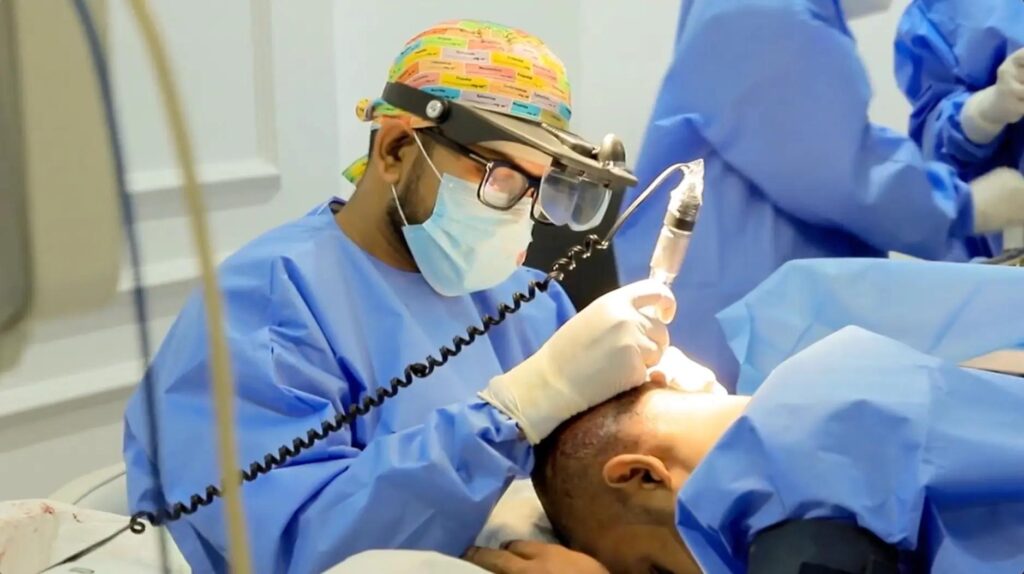
Hair Loss in Young Patients: When Is the Right Time to See a Doctor?

In This Article
- Understanding Early Hair Loss: Why Timing Matters
- Why a Hair Transplant Is Not Always the Right First Step
- What I See in Clinical Practice: The Cost of Acting Too Soon
- The Challenge of Hair Transplant Repair
- When Should You Actually See a Hair Specialist?
- The Dr Hair Approach: Diagnosis Before Decision
- Advanced Hair and Scalp Analysis
- Root Cause Identification
- Medical Stabilisation: The Step Before Surgery
- When Is a Hair Transplant Actually Appropriate?
- Think Long-Term: Hair Restoration Is a Lifetime Strategy
- Begin with a Consultation, Not a Commitment
In today’s image-conscious world, hair plays a significant role in personal identity, confidence, and how we present ourselves — particularly for younger individuals. When hair loss begins early, it can feel urgent and distressing, and the instinct for many is to seek a permanent solution as quickly as possible.
For a large number of young patients, that instinct leads them toward hair transplantation.
However, from a clinical and long-term aesthetic standpoint, surgery is rarely the right first step — and in some cases, acting too quickly can permanently limit your future options.
At Dr Hair, our approach is straightforward: hair restoration is not about immediate correction. It is about long-term preservation, careful planning, and surgical precision applied at exactly the right time.
Understanding Early Hair Loss: Why Timing Matters
The majority of young patients who come to us with hair loss are experiencing Androgenetic Alopecia — a progressive, genetically influenced condition driven by hormonal sensitivity in the hair follicles. It is the most common cause of hair loss in both men and women, and it behaves differently in every individual.
The central challenge with younger patients is that the condition is inherently unpredictable at early stages. Hair loss may progress slowly over many decades, or it may accelerate rapidly within a few years. It may stabilise at a mild stage, or it may evolve into advanced baldness. Without adequate time to observe the pattern, no surgeon can make fully informed decisions about hairline design, graft distribution, or long-term donor planning.
This unpredictability is precisely why early surgical intervention carries significant risk — not just in the short term, but across the patient’s entire lifetime.
Why a Hair Transplant Is Not Always the Right First Step
Hair transplantation is a highly refined surgical procedure — but it is also a resource-limited one. Understanding this distinction is essential for any patient considering it at a young age.
The donor area — the region at the back and sides of the scalp from which grafts are harvested — contains a finite, non-renewable supply of hair follicles. Every graft extracted is permanently removed from that area. There is no regeneration, no replenishment, and no way to reverse extraction once it has been performed.
This finite nature of the donor supply has a critical implication: every graft used today is one fewer available for the future. And for a young patient whose hair loss may continue to progress for another twenty or thirty years, that future demand could be considerable.
Poor planning at an early age does not just affect today’s results — it can permanently compromise every option available for the rest of the patient’s life.
“The donor area is a finite resource. Every decision made today shapes every option available tomorrow.” — Dr Tharindu Samarajeewa
What I See in Clinical Practice: The Cost of Acting Too Soon
In my practice, I regularly evaluate patients who have undergone hair transplants at a young age — often performed without adequate long-term planning, sometimes abroad, and sometimes without a thorough pre-operative assessment. The findings I encounter in these cases are consistent, and they are sobering.
The most common problems I see include:
- Over-harvested donor areas, leaving behind visible thinning, patchy density, or scarring that is difficult or impossible to conceal.
- Unnatural hairlines placed too low or too straight, designed without accounting for how the patient’s face and hairline will change with age.
- Low-density implantation that looks sparse and unconvincing, often because too few grafts were available or too large an area was attempted.
- Incorrect angulation and direction of implanted grafts, which disrupts the natural growth pattern and makes the result appear artificial.
These are not minor cosmetic imperfections. They are structural problems that define and limit everything that can be done afterwards.
The Challenge of Hair Transplant Repair
Hair transplant repair is one of the most technically demanding aspects of hair restoration — and one of the most emotionally difficult situations a patient can find themselves in.
When patients come to me seeking correction of a previous procedure, the clinical picture is often deeply constrained. The donor area has already been depleted, sometimes severely. The recipient area has been designed and implanted in a way that cannot simply be undone. And the scope for meaningful correction is limited — not by surgical skill, but by the simple reality that the resources required no longer exist.
In these situations, even with the most advanced techniques available, it may not be possible to achieve a satisfactory outcome. This is not something any surgeon wants to tell a patient — but it is a clinical reality that must be communicated honestly.
This is why prevention, through proper planning and appropriately timed intervention, is not just preferable — it is essential.
When Should You Actually See a Hair Specialist?
The most important message I want any young person experiencing hair loss to take from this article is this: early consultation is not about rushing toward surgery. It is about getting an accurate diagnosis, understanding your pattern, and putting the right plan in place before the situation becomes harder to manage.
You should seek a professional evaluation if you notice any of the following:
- Early thinning or a noticeable reduction in hair density, even if it seems minor
- A hairline that appears to be gradually receding
- Increased hair shedding beyond normal daily loss
- A family history of early or significant hair loss
- Visible scalp in specific areas, particularly the crown or temples
Early evaluation does not commit you to any treatment. It gives you information, options, and control — and in the case of hair loss, information gathered early is far more valuable than intervention sought in a panic.
The Dr Hair Approach: Diagnosis Before Decision
At Dr Hair, we do not begin with surgery. We begin with understanding — a thorough, evidence-based assessment of each patient’s individual situation before any treatment pathway is discussed. This structured approach is what allows us to make decisions that serve patients not just today, but for decades to come.
Advanced Hair and Scalp Analysis
Every patient begins with a detailed, high-resolution hair and scalp examination. This includes:
- High-resolution trichoscopy to assess hair shaft diameter, follicle density, and early miniaturisation
- Density mapping across the scalp to identify areas of active thinning
- Pattern mapping to understand the likely trajectory of hair loss over time
Root Cause Identification
Hair loss is rarely caused by a single factor. Our assessment looks beyond the scalp to identify the full picture:
- Genetic predisposition and family history of androgenetic alopecia
- Hormonal influences, including DHT sensitivity and thyroid function
- Nutritional deficiencies such as iron, ferritin, zinc, and vitamin D
- Lifestyle and stress factors that may be accelerating shedding
Medical Stabilisation: The Step Before Surgery
For the majority of young patients, the appropriate first step is not surgery — it is a personalised medical stabilisation programme. This phase is designed to slow or halt the progression of hair loss, improve the overall health of the scalp, and — in many cases — improve density before any surgical planning takes place.
This programme typically includes a combination of clinically validated pharmacological treatments, targeted scalp therapies, and correction of any identified nutritional or hormonal deficiencies. It is monitored closely over several months, with adjustments made based on individual response.
The outcomes of this phase can be significant. Many patients experience a meaningful reduction in hair shedding, visible improvement in hair thickness, and in some cases, partial recovery of density in areas of early thinning. For a number of patients, this phase alone substantially delays — or entirely removes — the need for surgical intervention.
When Is a Hair Transplant Actually Appropriate?
Hair transplantation is a powerful tool — but its results depend almost entirely on the conditions under which it is performed. At Dr Hair, we consider surgical intervention only when a specific set of clinical criteria are met:
- Hair loss has demonstrated signs of stability — meaning the pattern has not significantly progressed over a defined monitoring period.
- The loss pattern is sufficiently predictable to allow for safe, long-term hairline and density planning.
- Medical treatment has been optimised — ensuring that any contributing factors have been addressed and the patient is on the strongest non-surgical footing possible.
- There is a clearly defined, finite area requiring restoration — not an evolving or unpredictable zone of thinning.
When these criteria are met in younger patients, transplantation can absolutely be performed — but only with a conservative, strategic approach that protects the donor area and accounts for decades of potential future change.
Candidacy for hair transplantation is not simply a matter of age. It is a matter of pattern stability, donor capacity, and long-term planning.
Think Long-Term: Hair Restoration Is a Lifetime Strategy
A hair transplant is not a one-time decision. For the majority of patients — particularly those who begin losing hair at a young age — it is the first step in a lifelong relationship with hair restoration. How that first step is planned and executed determines what every subsequent step can look like.
Once the donor area has been compromised through over-harvesting or poor planning, the options available for future correction become severely limited. This is not a reversible situation. It is one that follows a patient for the rest of their life.
This is why, at Dr Hair, surgical restraint, ethical planning, and long-term thinking are not optional values — they are the foundation of every decision we make.
“The goal is not to solve today’s problem at the cost of tomorrow’s options. It is to build a strategy that serves you for life.” — Dr Tharindu Samarajeewa
Begin with a Consultation, Not a Commitment
If you are experiencing early hair loss, the most valuable step you can take right now is not surgery — it is professional evaluation and honest guidance.
At Dr Hair, we work with each patient to understand their individual pattern, identify the underlying causes of their hair loss, and build a long-term plan that prioritises their future as much as their present. Whether that plan involves medical management, surgical intervention, or a carefully timed combination of both — it will always be built on a foundation of clinical precision and realistic, honest expectations.
The earlier you seek guidance, the more options you will have. That is always true in hair restoration — and it is the single most important reason not to wait.