

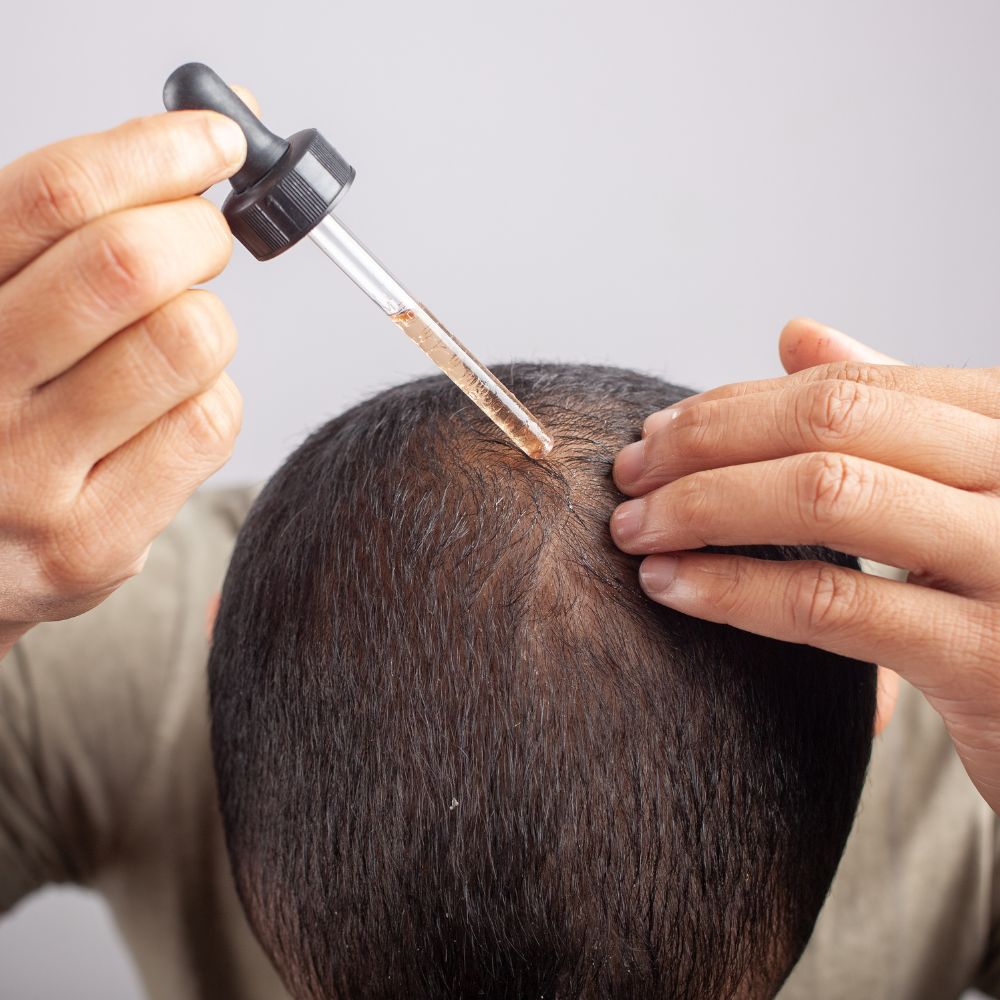
Minoxidil for Hair Loss: Does It Work? A Specialist’s Honest Guide

In This Article
- Does Minoxidil Actually Work?
- How Does Minoxidil Work?
- Why Am I Shedding More After Starting Minoxidil?
- Topical vs Oral Minoxidil: Which Is Better?
- How Long Until You See Minoxidil Results?
- Who Should NOT Use Minoxidil?
- Minoxidil vs Hair Transplant: Which Do You Need?
- Frequently Asked Questions About Minoxidil
- Does minoxidil work for everyone?
- How long do you have to use minoxidil?
- Is minoxidil safe for long-term use?
- Can women use minoxidil?
- What are the main side effects of minoxidil?
- Is minoxidil available in Sri Lanka?
- The Bottom Line
Minoxidil is a topical or oral medication used to slow hair loss and stimulate regrowth in androgenetic alopecia (pattern baldness). Originally developed as a blood pressure drug, it remains one of only two FDA-approved treatments for hair loss. It does not cure pattern baldness. Results depend on consistent, long-term use and stop when the medication is discontinued.
Does Minoxidil Actually Work?
The short answer: yes, for the right person, used consistently. The evidence is solid.
In a landmark randomised controlled trial published in the Journal of the American Academy of Dermatology, 5% topical minoxidil produced 45% more measurable regrowth than the 2% formulation at 48 weeks. A separate 12-month observational study of 984 men found that approximately 84% of users showed at least some improvement, with nearly half rating it “effective” and around 16% rating it “very effective.”
That said, minoxidil is not a miracle. Roughly 15–16% of users see no meaningful response, often linked to low activity of the enzyme (SULT1A1) that activates the drug inside hair follicles. In my practice, the patients who get the best results are those who start early, stay consistent, and have realistic expectations about the degree of regrowth they can achieve.
It is also worth noting the scale of the problem minoxidil is treating. Androgenetic alopecia affects an estimated 50 million men and 30 million women in the United States alone. By age 50, over half of men experience some degree of pattern hair loss. In Sri Lanka, the pattern is similar. At Dr. Hair, the majority of men presenting for assessment are in their 30s and 40s, exactly the demographic where early intervention with minoxidil can make a meaningful difference.
How Does Minoxidil Work?
Minoxidil is a prodrug with no effect in its raw form. Once applied to the scalp, an enzyme in the hair follicle called sulfotransferase (SULT1A1) converts it into the active form, minoxidil sulfate. This is why individual responses vary: patients with naturally lower SULT1A1 activity are partial or non-responders regardless of how diligently they apply it.
Once activated, minoxidil works through several mechanisms:
Vasodilation. Minoxidil sulfate opens ATP-sensitive potassium channels in blood vessel walls, causing them to relax and widen. This increases blood flow to the scalp, delivering more oxygen and nutrients to follicles.
Direct follicle stimulation. Beyond blood flow, minoxidil activates the Wnt/beta-catenin signalling pathway, a key driver of follicle cell proliferation, and increases local production of prostaglandin E2, which has both cytoprotective and pro-growth effects.
Cycle extension. In pattern hair loss, DHT progressively miniaturises follicles and shortens the active growth phase (anagen). Minoxidil counteracts this by prolonging anagen and shortening the resting phase (telogen), allowing follicles to produce longer, thicker, pigmented hairs again.
Importantly, minoxidil does not block DHT. It does not address the root hormonal cause of androgenetic alopecia. This is why results are maintained only with continuous use.
Why Am I Shedding More After Starting Minoxidil?
This catches many patients off guard, and it is the most common reason people stop treatment prematurely.
When minoxidil is first applied, it forcibly accelerates the hair cycle. Follicles that were in the resting (telogen) phase are pushed abruptly into the growth (anagen) phase. To begin growing, a follicle must first shed its existing resting hair. The result: a wave of simultaneous shedding in the first two to eight weeks of treatment, sometimes dramatic enough to alarm patients.
This initial shed is clinically known as minoxidil-induced telogen effluvium. It is not permanent hair loss. It is a sign the drug is engaging the follicles. The shedding typically peaks around weeks six to eight and resolves by week twelve. Visible regrowth follows at three to six months. Stopping treatment during the shed phase means you have experienced the temporary loss without giving the drug time to produce the new growth.
Topical vs Oral Minoxidil: Which Is Better?
Both forms are now well-supported by evidence, and the choice between them depends on your lifestyle, health profile, and how your scalp tolerates each.
| Feature | Topical Minoxidil | Oral Minoxidil |
|---|---|---|
| Form | Solution or foam, applied to scalp | Low-dose tablet (off-label) |
| Dosage (men) | 5% solution or foam, twice daily | 2.5–5 mg once daily |
| Dosage (women) | 2% solution, twice daily | 0.25–1.25 mg once daily |
| Best for | Patients wanting localised action; those with cardiovascular concerns | Patients with scalp sensitivity, poor compliance, or lifestyle preference |
| Results timeline | Visible at 3–6 months; peak at 9–12 months | Same general timeline |
| Key advantage | FDA-approved; minimal systemic absorption | Single daily dose; 0% stopped due to difficulty of use vs 18.8% of topical users |
| Key limitation | Greasy scalp; twice-daily application burden | Off-label; hypertrichosis risk 48.5% vs 6.25% topical |
A 2025 meta-analysis found no statistically significant difference in hair density or hair diameter between oral and topical formulations. A separate RCT published in JAMA Dermatology confirmed that oral minoxidil 5 mg once daily is similarly effective to the topical form. One nuance: oral minoxidil showed a 24% greater improvement at the crown compared with topical, though the difference at the frontal scalp was not significant.
In my practice at Dr. Hair, the men who struggle most with topical minoxidil are those who style their hair and find the greasiness disruptive. For them, low-dose oral minoxidil has become an increasingly useful option, provided there are no cardiovascular contraindications and they are counselled about the hypertrichosis risk, particularly relevant for women.
How Long Until You See Minoxidil Results?
Results follow a predictable timeline, regardless of whether you use topical or oral minoxidil:
- Weeks 2–6: Initial shedding phase, normal and expected
- Weeks 6–10: Shedding stabilises
- Months 3–6: Fine new hairs become visible; existing loss slows noticeably
- Months 6–9: Meaningful density improvement; hairs become thicker and darker
- Months 9–12: Peak results for most patients
A 5-year follow-up study confirmed that hair regrowth peaks at approximately one year of treatment, after which counts gradually decline, though they remain above untreated baseline for as long as treatment continues. This reinforces the long-term maintenance nature of minoxidil therapy.
Who Should NOT Use Minoxidil?
Minoxidil is not appropriate for everyone. Clear contraindications include:
- Pregnancy and breastfeeding: minoxidil carries teratogenic risk
- Known allergy to minoxidil or propylene glycol (the carrier in liquid formulations)
- Children under 18
- Pulmonary hypertension
The following require caution and specialist review before starting:
- Coronary artery disease or heart failure (oral minoxidil causes tachycardia and fluid retention)
- Significant renal impairment (reduced drug clearance increases systemic exposure)
- Broken, infected, or sunburned scalp (dramatically increases systemic absorption of topical)
- Multiple antihypertensive medications (additive blood pressure-lowering risk)
Minoxidil is also not the right treatment for alopecia areata, postpartum shedding, or other non-androgenetic causes of hair loss. If you have sudden, patchy, or unexplained hair loss without a confirmed androgenetic diagnosis, you should be assessed by a specialist before starting any treatment.
Minoxidil vs Hair Transplant: Which Do You Need?
These two treatments serve different stages of the same condition. They are not direct substitutes.
Minoxidil is most effective for early-stage diffuse thinning. It slows ongoing loss, maintains existing hair, and can recover some miniaturised follicles. It is the appropriate first-line medical treatment for someone in their late 20s or 30s noticing early recession or crown thinning who is not yet ready, or not yet a suitable candidate, for surgery.
A hair transplant becomes the better option when:
- Hair loss is significant or advanced (Norwood stage III and beyond)
- Medical therapy has been tried but produced insufficient results
- The patient wants a permanent, medication-free outcome
- The donor area is stable and supplies adequate grafts
One important detail: the two are not mutually exclusive. At Dr. Hair, many of our transplant patients continue minoxidil post-procedure to protect the non-transplanted areas and preserve density in hair that remains. The transplanted follicles are genetically resistant to DHT and do not require minoxidil to survive, but the surrounding native hair does.
The cost framing is also worth addressing honestly. Minoxidil costs roughly USD 30 per month, approximately USD 360 per year. Over a decade of continuous use, that exceeds USD 3,600. A single hair transplant, while a larger upfront investment, often represents the more cost-effective solution over a lifetime for patients with progressive loss.
Frequently Asked Questions About Minoxidil
Does minoxidil work for everyone?
No. Approximately 15–16% of users see no meaningful response. Response depends partly on the activity of the SULT1A1 enzyme in the hair follicle, which converts minoxidil into its active form. Patients with low enzyme activity are partial or non-responders. Age, stage of hair loss, and consistency of use also influence results.
How long do you have to use minoxidil?
Minoxidil must be used indefinitely to maintain results. It does not alter the underlying hormonal cause of pattern hair loss. According to discontinuation studies, hair loss resumes within three to six months of stopping, and regained hair is gradually lost. Approximately 86% of patients discontinue at some point, most commonly due to side effects or insufficient results.
Is minoxidil safe for long-term use?
Yes. Decades of clinical use support the safety of long-term topical minoxidil in both men and women. Oral minoxidil at low doses (0.25–5 mg/day) has a well-documented safety profile, though periodic monitoring of cardiovascular parameters is sensible, particularly in older patients or those with pre-existing conditions.
Can women use minoxidil?
Yes. A randomised controlled trial of 381 women published in JAAD confirmed that 5% topical minoxidil was statistically superior to placebo on all three primary endpoints. The standard starting formulation for women is 2% topical (lower hypertrichosis risk). Low-dose oral minoxidil at 0.25–1.25 mg/day is increasingly used for women who cannot tolerate topical application.
What are the main side effects of minoxidil?
For topical use: scalp irritation, dryness, and itching (most common, often resolved by switching from liquid to foam). Facial hypertrichosis occurs in up to 6.25% of topical users. For oral use: hypertrichosis is significantly more common (48.5%), and some patients experience tachycardia, fluid retention, or low blood pressure. Initial shedding in the first six to eight weeks occurs with both forms and is not a side effect to be alarmed by.
Is minoxidil available in Sri Lanka?
Yes, branded and generic topical minoxidil (2% and 5%) is available at pharmacies in Sri Lanka. Oral minoxidil requires a prescription and, given the cardiovascular monitoring required, should be initiated under medical supervision. At Dr. Hair, we assess patients for suitability and can advise on the most appropriate formulation and dosage for your specific pattern and stage of hair loss, rather than defaulting to whatever is easiest to source over the counter.
The Bottom Line
Minoxidil is a well-evidenced, accessible first-line treatment for androgenetic alopecia. Used consistently from early in the hair loss process, it can meaningfully slow progression and recover some lost density. Its limitations are equally important to understand: it is not a cure, it requires indefinite use, and roughly one in six patients will not respond adequately.
In my clinical experience at Dr. Hair, the patients who get the best outcomes from any hair loss treatment, whether minoxidil, oral therapy, or transplant, are those who receive a proper assessment first. Pattern hair loss exists on a spectrum. What is appropriate for early diffuse thinning is different from what a patient with advanced recession needs. Self-medicating without understanding your stage, your DHT sensitivity, or your donor capacity can mean spending years on a treatment that was never the right tool for your situation.
If you are noticing hair thinning or loss and are unsure whether minoxidil, a transplant, or another approach is right for you, book a free consultation with our team at Dr. Hair. We will assess your loss pattern, explain your options, and give you an honest clinical picture. Not a sales pitch.
Book a Free Hair Loss Consultation at Dr. Hair →
Written by Dr. Tharindu, Hair Transplant Specialist at Dr. Hair Sri Lanka