

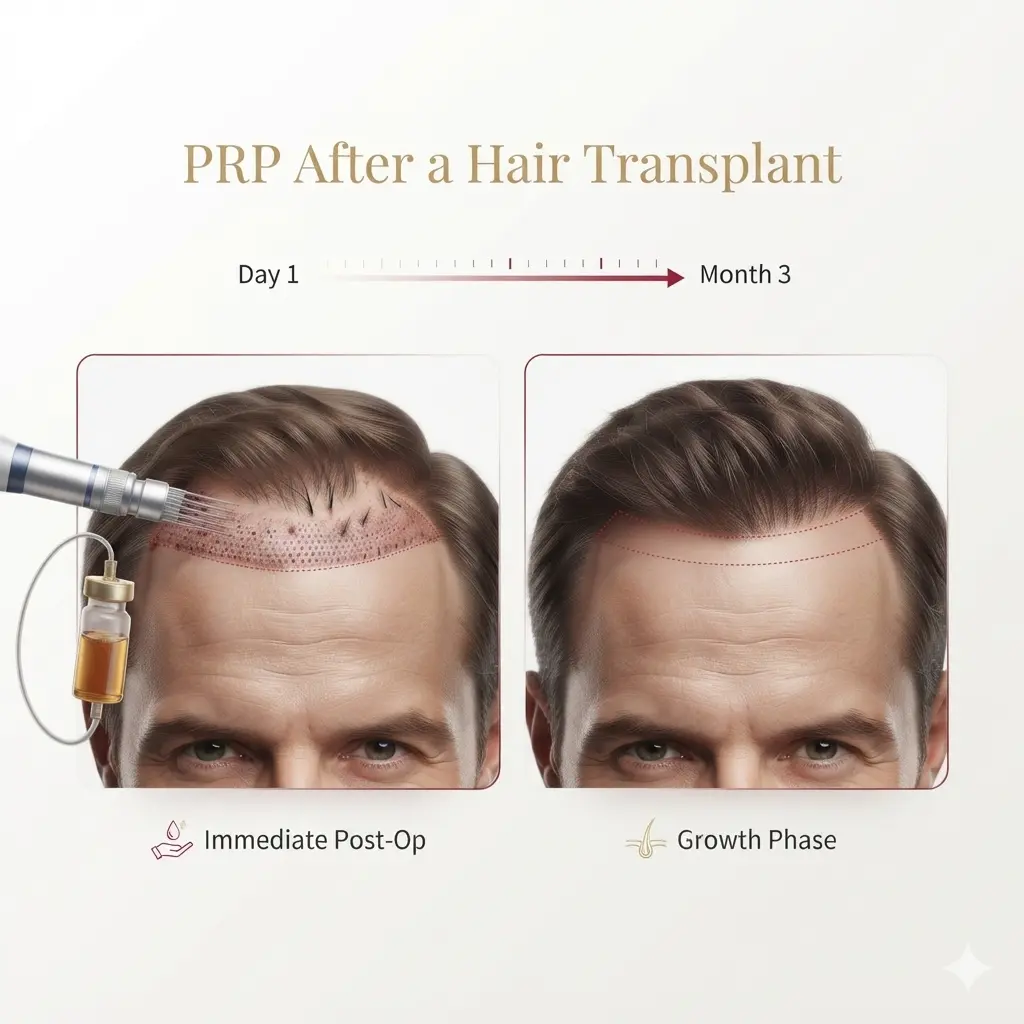
PRP After a Hair Transplant: Why Many Patients Do Both

In This Article
- The Problem a Transplant Does Not Solve
- Where PRP Fits, and What It Cannot Do
- What the Evidence Actually Shows
- Shedding After Surgery: What Is Normal
- Timing: When PRP Is Used Around Surgery
- PRP, Minoxidil and Finasteride After a Transplant
- Who Benefits Most From the Combination
- Frequently Asked Questions About PRP After a Hair Transplant
- How soon after a hair transplant can I have PRP?
- Does PRP stop the shedding after a transplant?
- Do I still need finasteride or minoxidil if I am having PRP?
- Can PRP regrow hair on a bald area instead of a transplant?
- Is PRP after a hair transplant safe?
- If the evidence is this thin, is PRP worth doing at all?
- The Bottom Line
PRP and a hair transplant are frequently used together, not as alternatives. A transplant restores hair to areas that are already bald; PRP is aimed at the native hair around and between the transplanted grafts, which the surgery does nothing to preserve. That is the honest case for combining them. The less comfortable half is that the published evidence for PRP as a transplant adjunct is remarkably thin, and you deserve to hear that before you pay for it.
This is the “why not both” answer to the question I set up in PRP or hair transplant. Read that first if you are still deciding; this one is about combining them once surgery is part of the plan.
The Problem a Transplant Does Not Solve
A hair transplant is very good at one thing: moving healthy, DHT-resistant follicles from the safe donor zone into a bald or thinning area, where they grow permanently. What it does not do is change the genetics of the hair already on your head. The StatPearls hair transplantation reference is direct about what follows from that. Patients typically need long-term oral and topical therapy to control the progression of hair loss, and finasteride is to be continued through the perioperative period and indefinitely afterwards. Surgery treats the bald patch. It does not treat the condition that created it.
The consequence is easy to picture. A transplant can restore a bald crown beautifully while the surrounding native hair keeps miniaturising. The transplanted zone holds; the area next to it moves on. Over ten years that mismatch turns an excellent operation into a disappointing result.
The best evidence for how much this matters comes not from PRP but from finasteride. In a randomised, double-blind, placebo-controlled trial in Dermatologic Surgery (2005), 79 men aged 20 to 45 took finasteride 1 mg or placebo daily from four weeks before their transplant until 48 weeks after. Visible increases in scalp hair were recorded in 94% of the finasteride group versus 67% on placebo. Read the placebo arm again: roughly a third of men who had surgery showed no visible gain at one year, because ongoing native loss cancelled out what the operation added. Closing that gap is the whole job of a post-transplant programme, and it is why I separate hair that is gone from hair that is merely miniaturising in is my hair loss reversible.
Where PRP Fits, and What It Cannot Do
PRP is prepared from your own blood, spun to concentrate the platelets, then injected into the scalp. The rationale is that growth factors released by those platelets stimulate follicles that are alive but miniaturising. After a transplant that means the native hair around the grafts, not the grafts themselves, which are DHT-resistant and do not need PRP to survive.
Now the limit I state to every patient before they book anything: PRP cannot regrow hair on a scalp that is already bald. There is no follicle left to stimulate in a truly bald area; a growth factor injected into skin with no living follicular unit beneath it has nothing to act on. PRP preserves and thickens hair that still exists in some form. Any clinic implying otherwise is selling something the biology does not support.
The regulatory picture reinforces that caution. Only oral finasteride and topical minoxidil are FDA-approved for androgenetic alopecia; PRP is not approved for hair loss and is used off-label. A 2025 review in Medical Sciences explains why. Because autologous PRP is classed as “minimally manipulated” it is generally exempt from a Biologics License Application, and PRP devices reach the market through 510(k) clearance, which requires only that a device be safe and “substantially equivalent” to an existing one, with less emphasis on clinical efficacy. That does not make PRP useless, but the correct category is “plausible adjunct”, not “proven treatment”. For how a session is performed, see PRP hair treatment in Sri Lanka.
What the Evidence Actually Shows
A systematic review in Cureus (October 2025) assessed PRP as an adjunct to hair transplantation. The entire published evidence base consists of three studies, two randomised controlled trials and one non-randomised study, totalling 217 participants. That was too few and too varied for a meta-analysis, as the reviewers said explicitly. The findings are encouraging, and small:
- Graft survival. In a 30-patient RCT (15 PRP, 15 control), follicle survival at six months was 82.2% with PRP versus 74.0% in controls (p=0.002), a gap of about eight percentage points.
- Speed of onset. In the same trial, growth began at 17.7 days versus 20.1 days (p=0.015). Statistically real; in the mirror, essentially invisible.
- Regrowth grade. A single-blind RCT of 40 FUE patients in the Journal of Cutaneous and Aesthetic Surgery (2016) injected PRP intra-operatively, controls receiving saline. At six months, 100% of the PRP group achieved more than 75% regrowth versus a small minority of controls.
- As a graft holding solution. A separate randomised pilot of 20 men stored grafts in PRP rather than chilled Ringer’s lactate and found higher density at six months (31.0 versus 25.5 follicular units per cm2, p=0.007).
The caveats matter just as much:
- Two studies were rated as having “some concerns” for bias; the non-randomised one carried a serious risk from confounding and selection bias.
- None used standardised evaluation tools or trichoscopy, and follow-up ran from only eight weeks to six months. Nobody has published what happens after that.
- The graft-storage authors limited their own conclusions, citing the small sample and a follow-up they judged possibly too short. The 2016 trial’s control figure is reported differently across sources, which is why I describe it qualitatively rather than quoting a number.
Widen the lens to PRP for androgenetic alopecia generally and there is more data, and it is messier. The largest meta-analysis I can find, in Dermatology and Therapy (November 2025), pooled 43 RCTs and 1,877 participants: activated PRP increased hair density versus placebo, but had no significant effect on hair thickness. A 2024 meta-analysis in Anais Brasileiros de Dermatologia pooled 13 RCTs and 431 patients, calculated a mean gain of 27.55 hairs per cm2, then reported extreme heterogeneity (I2 around 96%), evident publication bias, and graded its own finding low-quality. A 2024 systematic review in the Journal of Cosmetic Dermatology, covering nine studies and 291 participants, found most reported a density increase but rated seven of the nine at moderate risk of bias and concluded that the low quality of evidence and high heterogeneity limit what can be inferred from them.
Read together, those three say the same thing: a pooled number exists, but it is not a settled one. There are credible negative trials too. A randomised, placebo-controlled pilot of 30 men in Acta Dermato-Venereologica (2020) found no improvement by either TrichoScan or independent visual assessment, and concluded that PRP as a monotherapy does not improve hair growth in men with androgenetic alopecia. My reading, and the line I take with patients at Dr. Hair: the direction of the evidence is mildly favourable, the effect sizes are modest, the certainty is low, and the honest word is adjunct.
Shedding After Surgery: What Is Normal
Two kinds of shedding follow a transplant, and patients constantly confuse them. The transplanted hairs shed within days of surgery. This is normal: the follicle stays, only the hair it was carrying is lost. New growth generally emerges between three and six months and matures over six to twelve, which is why we photograph results at six to twelve months.
Native hair around the grafts can also shed. This is recipient-site effluvium, or shock loss. A 2026 review of FUE complications in Frontiers in Medicine reports an incidence of 0.15% to 15%, a range that wide because studies define it differently. A retrospective study of 621 FUE patients in Aesthetic Plastic Surgery (2024) found 23 cases, about 3.7%. It typically begins two to eight weeks after surgery, with regrowth around three months. You will see claims elsewhere that 60 to 80% of patients get shock loss; I cannot find those figures in any peer-reviewed source and they are contradicted by the data above.
The mechanism is multifactorial: disruption of the hair cycle by surgical trauma, perifollicular inflammation, local ischaemia, and vasoconstrictors such as the epinephrine in local anaesthesia. Contributing factors include high implantation density (50 to 70 follicular units per cm2), over-tumescence and stress. Risk is not evenly spread: in the 621-patient study, female sex was a strong risk factor (odds ratio 30.18), with increasing age raising it further among women.
Now the part that needs stating clearly: no randomised trial has ever tested PRP with reduction of post-transplant shock loss as its primary endpoint. The 2026 review describes platelet therapies as having been proposed to enhance wound healing and modulate post-operative inflammation, with potential benefit for graft survival, then states that transplant-specific evidence remains limited. Proposed is not demonstrated. A clinic promising PRP will prevent your shock loss is describing a hypothesis as a finding. The same review reports folliculitis in roughly 12% of FUE cases, oedema in 40 to 50% and infection in under 1%, figures we go through in advance as part of post-transplant care.
Timing: When PRP Is Used Around Surgery
The most searched question here is “how many weeks after my transplant can I have PRP?”, and the literature does not settle it. Across the three published adjunct studies, PRP was given intra-operatively in one, four weeks after surgery in another, and before surgery plus again at one and two months in the third. Blood volumes ranged from 20 mL to 500 mL. No comparative trial has established an optimal window. The “three to six weeks” figure repeated across clinic websites does not come from a peer-reviewed source, and I will not repeat it as though it did.
What is well evidenced is why the earliest window needs care. A pilot study of 42 patients by Bernstein and Rassman in Dermatologic Surgery (2006) found that on days one and two, pulling on a hair always cost a graft; by day six grafts resisted dislodgement; by day nine they were no longer at risk. That concerns handling rather than injections, but it is why nothing mechanical should touch a fresh recipient area in week one.
There are two distinct roles for PRP around surgery, and they should not be blurred:
- Protecting native hair, the main rationale. Ongoing maintenance PRP aimed at the surrounding non-transplanted hair that is still miniaturising. It is a long game, and it is why most of my combined-plan patients are having PRP at all.
- Peri-operative use aimed at the grafts and healing scalp. This is what the small adjunct trials studied. It is a case-by-case clinical judgement, to be discussed with your surgeon rather than assumed.
Session numbers are equally unsettled. A review in the International Journal of Women’s Dermatology confirmed there is still no standardised method of PRP preparation or application; reported schedules ran from one session to six, spaced anywhere from two weeks to three months apart. One nuance on assessment: reported density gains grow with time, from roughly +8 to +19 hairs per cm2 at three months up to +23 to +49 at six months. Judging PRP at three months, exactly when anxious post-transplant patients want to judge everything, understates it. Whether you have had FUE or another technique, the timeline is the same: six months minimum, twelve for the real answer.
PRP, Minoxidil and Finasteride After a Transplant
PRP is not the only candidate for your post-operative plan, and it is not the best evidenced. A standard regimen described in StatPearls is minoxidil 5% twice daily to recipient and donor areas from five to seven days after surgery, with oral finasteride continued through the perioperative period and indefinitely afterwards.
| Treatment | Strongest transplant-specific evidence | Regulatory status | Honest limitation |
|---|---|---|---|
| Finasteride | Randomised double-blind placebo-controlled trial, 79 men; 94% vs 67% visible improvement at 48 weeks | FDA-approved | Systemic drug needing counselling; not suitable for everyone |
| Topical minoxidil | Only a 1987 pilot of 12 patients using 3% solution; 2 showed graft growth without the usual shedding | FDA-approved | Post-transplant evidence preliminary and decades old; indefinite daily use |
| PRP | Three studies, 217 patients, none followed beyond 6 months; no meta-analysis possible | Not approved; off-label; devices cleared on 510(k) equivalence | Small, heterogeneous evidence; no standard protocol; negative trials exist |
The hierarchy is obvious. Finasteride has by far the strongest trial evidence in transplant patients, supported by long-term observational data: three Japanese investigations summarised in Hair Transplant Forum International (2022), covering 3,177 cases over two and a half years, 801 over five years and 532 over ten, reported prevention of progression in 99.6%, 100% and 99.1% of cases, with adverse reaction rates of 0.7% at two and a half years and 6.8% at ten. Minoxidil is well evidenced for androgenetic alopecia in general, as I have covered in minoxidil for hair loss, but its post-transplant evidence is that 1987 pilot, whose own author wrote that carefully controlled studies were needed to substantiate it. Nobody has run them.
Crucially, no trial has compared PRP head to head with minoxidil or finasteride after surgery, so I never present PRP as a substitute for medical therapy in a suitable candidate. It sits alongside: for people who cannot or will not take a systemic drug, and for people already on medication who want another lever.
Who Benefits Most From the Combination
In my practice at Dr. Hair, the patients for whom the combination makes clearest sense share a few features:
- A defined bald area needing surgery and native hair still worth protecting. PRP acts on what is alive; surgery covers what is not.
- Younger patients with years of future loss ahead. The longer the horizon, the more ongoing native loss matters.
- Patients who cannot or prefer not to take finasteride. PRP is not equivalent, and I say so, but for someone who has ruled out systemic medication it is one of the few remaining levers on native hair.
Equally, there are patients I do not push it on. Where loss is near-complete and little native hair survives, PRP has almost nothing to act on, and the sensible conversation is about donor supply. The safe donor zone typically carries 65 to 85 follicular units per cm2, and that arithmetic, not an injection, determines what is achievable in an advanced case.
One thing patients rarely consider: “PRP” is an umbrella term, not a defined product. Research suggests a platelet concentration two to six times baseline is needed for optimal outcomes, and at least three competing classification systems exist, so two clinics can both offer “PRP” and inject materially different preparations. Regulation also permits non-physicians to administer it, so ask who is injecting and what the system produces. This is why we treat surgery and non-surgical care as one plan rather than two separate purchases, as part of our combined hair restoration services: the honest measure of a result is how it looks at ten years, not at twelve months.
Frequently Asked Questions About PRP After a Hair Transplant
How soon after a hair transplant can I have PRP?
There is no evidence-based answer, and be wary of anyone who gives you a confident one. The published adjunct studies used three different schedules and no trial has compared them. What is documented is that grafts are fragile early: dislodgeable on days one and two, resistant by day six, safe by day nine. Your surgeon should make the call.
Does PRP stop the shedding after a transplant?
No randomised trial has tested that. Platelet therapies have been proposed to modulate post-operative inflammation and support graft survival, but the 2026 Frontiers in Medicine review describing that mechanism states transplant-specific evidence remains limited. Separately, shedding of the transplanted hairs within days of surgery is normal, and nothing is meant to prevent it.
Do I still need finasteride or minoxidil if I am having PRP?
Probably, if you are a suitable candidate. Finasteride is the only treatment with a randomised, placebo-controlled trial run specifically around transplant surgery: 94% visible improvement at 48 weeks versus 67% on placebo. Minoxidil is FDA-approved and part of standard post-operative regimens. No trial has compared PRP with either drug after surgery, so treat PRP as an addition, not a replacement.
Can PRP regrow hair on a bald area instead of a transplant?
No. PRP stimulates follicles that are still present but miniaturising. Where a scalp is genuinely bald there is no surviving follicle for growth factors to act on, and no amount of PRP changes that. It is the most important thing to understand about PRP, and why it and surgery are complements rather than competitors.
Is PRP after a hair transplant safe?
PRP is made from your own blood, which removes the risks of foreign material, and the 43-trial meta-analysis described it as relatively safe. One nuance from that same analysis: non-activated PRP was associated with a higher frequency of adverse effects than activated PRP. The larger consideration is the operator, since regulation permits people without specialised credentials to administer it.
If the evidence is this thin, is PRP worth doing at all?
The evidence is small, short-term and low-certainty, and at least one placebo-controlled study concluded PRP monotherapy does not work in men with androgenetic alopecia. Against that, the mechanism is plausible, the material is your own blood, the reported effects point in a favourable direction, and the alternative for someone who declines medication is often nothing at all. A reasonable option with modest expected benefit, not a guaranteed one.
The Bottom Line
Many patients do both because the two treatments answer different problems. A transplant restores coverage where hair has already gone. PRP is aimed at the native hair surgery leaves untouched and androgenetic alopecia keeps attacking, which is why the standard references call for long-term medical therapy after surgery. What PRP cannot do, under any protocol and at any concentration, is regrow hair on a scalp that is already bald.
The evidence deserves the same honesty. PRP as a transplant adjunct rests on three studies and 217 patients: no meta-analysis possible, no follow-up beyond six months, no standard protocol, no trial testing shock loss as a primary endpoint. The wider androgenetic alopecia literature has more data but extreme heterogeneity, documented publication bias, moderate risk of bias in most trials and at least one credible negative result. Finasteride, not PRP, has the strongest post-transplant evidence.
In my clinical experience the patients who do best are not the ones who buy the most treatments. They are the ones assessed properly first, who then commit long enough for the plan to be judged fairly at six and twelve months. Combining PRP with a transplant is a sound strategy for the right scalp, not a guarantee, and I would rather you heard that before the procedure than worked it out afterwards.
If you are planning a transplant and want to know whether PRP has a genuine role in your case, book a consultation at Dr. Hair. We will assess your donor supply, your native hair and your stage of loss, and give you an honest picture. Not a sales pitch.
Book a Consultation at Dr. Hair →
Written by Dr. Tharindu, Hair Transplant Specialist at Dr. Hair Sri Lanka