

PRP or Hair Transplant: Which One Do You Actually Need?

In This Article
- The Distinction Everything Else Depends On
- What the Evidence Actually Says About PRP
- Why PRP Results Vary So Much Between Clinics
- What the Evidence Says About a Hair Transplant
- PRP or Hair Transplant: A Side-by-Side Comparison
- The Combined Case: Why Many Patients Need Both
- Special Situations Worth Flagging
- Frequently Asked Questions
- Can PRP regrow hair on a bald spot?
- Is PRP or a hair transplant better?
- Does PRP actually work, or is it a waste of money?
- Do I still need PRP or medication after a hair transplant?
- How many PRP sessions will I need?
- Why did PRP work for my friend and not for me?
- The Bottom Line
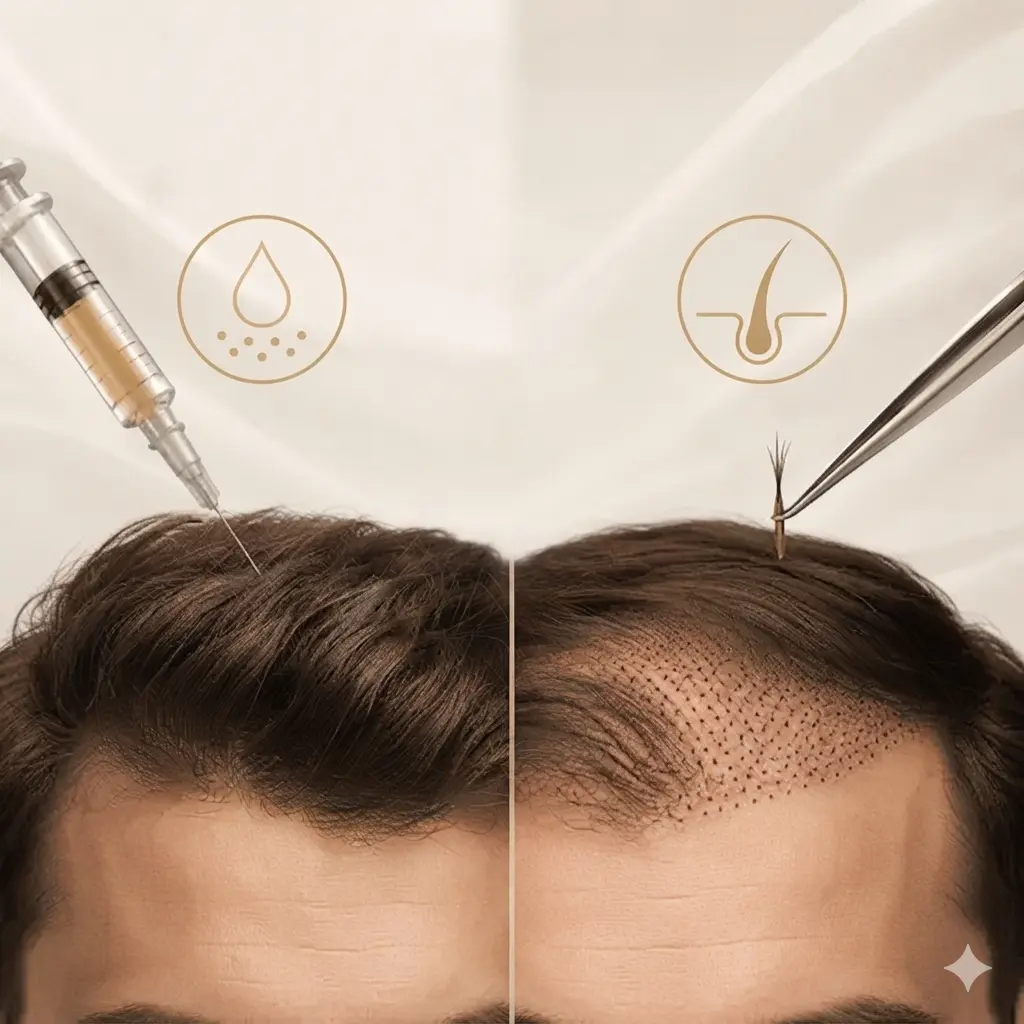
PRP and a hair transplant are not two versions of the same treatment, and they are not true alternatives. PRP (platelet-rich plasma) can thicken hair that is thinning but still present. A hair transplant moves healthy follicles into areas where hair is already gone. Which one you need depends on one question: is there still living hair in the area that bothers you? The evidence behind each is very different in quality, and knowing that difference is what stops you paying for the wrong thing.
The Distinction Everything Else Depends On
Pattern hair loss is a gradual process, not an on-off switch. Follicles affected by DHT shrink over years, producing progressively finer, shorter hairs, a process called miniaturisation, before they eventually stop producing hair at all. That progression is the entire decision framework:
- A miniaturising follicle is alive. It can respond to stimulation. This is where PRP works, when it works at all.
- A follicle that has fully stopped producing hair cannot be revived. No injection, serum, or supplement brings it back. This is where only a transplant restores coverage.
If you take one thing from this article, make it that sentence: PRP cannot regrow hair in an area that is already bald. Any clinic that promises otherwise is selling you something the biology does not support. I have written in more detail about whether your hair loss is still reversible, which is the clinical version of this same question.
The research supports that split indirectly. A longitudinal comparative study of 93 patients (51 men, 42 women) published in Clinical Drug Investigation in 2019 found the best PRP responses at Norwood-Hamilton grades II to III in men and Ludwig grade I in women, with higher grades responding progressively less well. PRP performs best exactly where there is still miniaturising hair to rescue. Worth saying plainly, too: no randomised trial has ever compared PRP directly against a hair transplant. None exists, because the two answer different clinical questions, so anyone presenting a head-to-head winner is extrapolating rather than citing.
What the Evidence Actually Says About PRP
PRP appears to have a real but modest effect. It also has one of the shakiest evidence bases in dermatology, and patients deserve both halves of that sentence.
Two independent meta-analyses land in almost the same place. A 2024 systematic review in Anais Brasileiros de Dermatologia, pooling 13 of 14 randomised trials across 431 patients, found PRP increased hair density by a mean of 27.55 hairs per square centimetre versus control (95% CI 14.04 to 41.06). A 2023 meta-analysis in Aesthetic Plastic Surgery, covering 10 randomised trials and 318 participants, found density 25.09 hairs per square centimetre higher than control (95% CI 9.03 to 41.15, p = 0.002). Now the caveats, which matter more than the headline:
- Low certainty by the authors’ own grading. The 2024 review graded its hair-density evidence LOW under GRADE and its hair-diameter evidence VERY LOW, downgraded for heterogeneity, small samples and publication bias.
- The trials disagree violently. Statistical heterogeneity reached 95.99%, meaning nearly all the variation between results is genuine disagreement rather than chance. That makes a pooled average fragile.
- Publication bias is visible. The same review reported funnel plot asymmetry indicating a clear presence of publication bias, though Egger’s test was not significant (p = 0.3115). Negative studies are probably under-represented.
- Density improves; calibre may not. The 2023 analysis found no significant effect on hair diameter (SMD 0.57, 95% CI -0.23 to 1.38, p = 0.16). More hairs, not necessarily thicker ones.
- One well-run trial found nothing. A randomised, placebo-controlled, blinded pilot study of 30 men in Acta Dermato-Venereologica found no significant difference in hair count at any point (p = 0.817 at four weeks; p = 0.366 at six months), concluding that PRP monotherapy does not improve hair growth in men with androgenetic alopecia.
There is a subtler problem too. Most PRP trials use a split-scalp design, PRP on one side and placebo on the other. A 2022 review in the Journal of Cosmetic Dermatology found hair density at six months was 37 hairs per square centimetre higher on the placebo side of split-scalp trials than in the placebo arms of whole-head trials, consistent with PRP diffusing across the midline into the supposedly untreated side. The design used most often is the design least able to detect a difference.
Two further gaps. The mechanism is unsettled: the American Academy of Dermatology lists competing hypotheses involving TGF-beta, PDGF, FGF-7 and VEGF-mediated angiogenesis, and says how these growth factors modulate the hair cycle is still unclear. And there is no long-term data, the 2023 meta-analysis being explicitly unable to assess effects beyond twelve months. If a clinic tells you exactly how long your PRP results will last, they are not reading the literature.
Why PRP Results Vary So Much Between Clinics
Patients ask me why a friend had an excellent PRP result and a cousin had none. Part of the answer is patient selection; a large part is that “PRP” is not one thing. The AAD puts it bluntly: we lack a universally agreed methodology for the preparation, centrifugation and administration of PRP, and activation methods, devices and number of spins all vary between users. PRP typically contains a platelet concentration two to five times that of whole blood, but “typically” carries a lot of weight there.
The most uncomfortable finding in the field appeared in the Journal of the American Academy of Dermatology in 2021. Researchers audited three closed, FDA-cleared PRP devices in routine clinical use. Average platelet enhancement relative to the patient’s own whole blood was 0.4, 2.9 and 0.3, meaning two of the three produced plasma less platelet-rich than the blood it was made from. The authors concluded that PRP concentration may not reach what the clinician intends at the time of injection, while carefully adding that whether this changes outcomes is unknown.
Variation is not only mechanical: work in Experimental Dermatology suggests growth factor output from platelets differs between individual patients. Meanwhile a variable clinics market heavily appears not to matter, a 2025 meta-analysis in Frontiers in Medicine finding no significant difference between single-spin and double-spin centrifugation (p = 0.36).
One variable does appear to matter: scheduling. A blinded randomised trial of 40 patients in Dermatologic Surgery compared three monthly injections plus a booster at three months against two injections spaced three months apart, and mean hair-count change was 29.6% versus 7.2% (p < 0.001). The AAD describes a common protocol of three treatments one to two months apart followed by maintenance, while stating openly that its preferred frequency may change once the optimal one is established.
It also has to be said, because clinics rarely volunteer it: PRP is not FDA-approved for hair growth, and PRP devices have not been cleared by the FDA for alopecia. That is the AAD’s own wording. Not a reason to dismiss the treatment, but a reason to distrust marketing that implies regulatory endorsement. For what a course involves, see PRP hair treatment in Sri Lanka.
What the Evidence Says About a Hair Transplant
Transplantation sits at the opposite end of the spectrum: the short-term outcome data is far stronger, while the long-term constraint is far harder. The procedure rests on a principle described by Orentreich in 1959 and known as donor dominance: transplanted follicles keep the characteristics of the site they came from, including resistance to miniaturisation, wherever they are moved. That is why a transplant is permanent in a way no injection can be. Our page on FUE hair transplant covers how the extraction technique works.
A retrospective analysis of 158 men treated with FUE, published in BMC Surgery in 2024, reported over 90% follicle survival at one to two years, satisfaction above 98%, and an overall complication rate under 6% (pinpoint scarring 1.3%, folliculitis 1.3%, oedema 2.5%). That is a single-institution series, not a randomised trial, so read it as a good result from a good unit rather than a universal guarantee. At scale, a 2025 systematic review in Aesthetic Plastic Surgery covering 45 articles and 2,380 patients concluded that hair transplant surgery is generally safe, with pain and discomfort the most frequently reported complication (63.57% in observational studies). Discomfort is common; complications that threaten the result are not. I have written separately about what a hair transplant actually feels like.
The honest counterweight is that graft survival is not a fixed property of the operation. A controlled paired-graft study published in the ISHRS Hair Transplant Forum International, tracking 1,780 follicles in just four patients, found 61.4% survival for FUE against 86.0% for strip-harvested grafts in the same scalps, with a surgeon who had performed roughly 90 prior FUE cases. Four patients is far too small to settle anything, and it does not show that FUE is inferior; what it does show is that operator experience influences survival more than the acronym does. Stage and age matter too: a two-centre study of 52 men in the Medical Journal Armed Forces India found significantly better outcomes in patients under 33 and below Norwood 4a.
Then the constraint no technique engineers away: donor supply is finite. The occipital donor area typically carries 65 to 85 follicular units per square centimetre, with documented variation between ethnic groups. Every graft moved cannot be moved again, which is why a careful surgeon plans for the pattern you will have at 55, not the one you have today.
PRP or Hair Transplant: A Side-by-Side Comparison
| Feature | PRP | Hair transplant |
|---|---|---|
| What it does | Stimulates follicles that are alive but miniaturising | Relocates DHT-resistant follicles into areas with no hair |
| Works on a bald area? | No | Yes, this is its purpose |
| Best-supported candidate | Norwood-Hamilton II-III in men, Ludwig I in women (n=93) | Below Norwood 4a and younger patients did significantly better (n=52) |
| Typical measured effect | +25 to +28 hairs per square centimetre vs control across two meta-analyses | Over 90% follicle survival at 1-2 years in a series of 158 men |
| Strength of evidence | LOW under GRADE for density, VERY LOW for diameter; heterogeneity near 96% | Mostly observational and retrospective, but consistent |
| Regulatory status | Not FDA-approved for hair growth; devices not cleared for alopecia | A surgical procedure, not a drug approval question |
| Permanence | Unknown beyond about 12 months; no durability data | Permanent by donor dominance |
| Main adverse effects | Pain, swelling, bleeding, lightheadedness, redness; usually self-resolving within 24 hours | Pain and discomfort commonest; serious complications uncommon |
| Main limitation | Cannot restore hair where follicles are gone | Finite donor supply; does not protect surrounding native hair |
On cost I will not quote clinic prices. What does exist is a Markov decision analysis in Cureus (2021), drawing on 18 level I and II prospective studies over a 35-year horizon, which estimated total healthcare-perspective costs of USD 1,463 for minoxidil, USD 13,103 for PRP and USD 15,209 for both combined, with minoxidil alone the most cost-effective at a USD 50,000 willingness-to-pay threshold. Those are modelled US figures over decades, not prices in Colombo. The transferable point is that PRP is a recurring cost with an uncertain endpoint.
You cannot diagnose yourself in a mirror, but you can get a useful first read:
- Early, diffuse thinning with hair still present. Your scalp shows through under bright light, but there is still hair across the area. Those follicles are likely miniaturising rather than dead, so PRP is worth considering, usually alongside medical treatment, and a transplant may not be needed yet.
- Visible scalp with no hair in the area. A bald crown, a hairline that has clearly moved back, smooth skin where hair used to be. PRP will not bring that back; a transplant is the treatment that addresses it.
- A mix of both, which is what I see most often in clinic: a genuinely bald zone at the front or crown, surrounded by native hair that is itself thinning.
Staging language has limits: a 2016 review in the Journal of Cutaneous and Aesthetic Surgery criticised the Hamilton-Norwood classification as too complicated for surgical use and not very helpful in determining the surgical method. Useful shorthand, not a treatment plan.
| Your situation | Likely direction |
|---|---|
| Thinning, but hair still covers the area | PRP, usually with medical treatment |
| Clearly bald zone, stable elsewhere | Transplant |
| Bald zone plus thinning around it | Transplant for the bald zone, PRP or medication to protect the rest |
| Diffuse thinning all over (common in women) | PRP and medical treatment first; surgery only in selected cases |
| Sudden or patchy loss | Neither, see a doctor for a diagnosis first |
| Thinning visible in the donor zone itself | Neither yet; donor involvement changes the whole plan |
The Combined Case: Why Many Patients Need Both
A transplant restores the bald zone. It does nothing to protect the surrounding native hair, which carries the same DHT sensitivity that caused the original loss, and if that hair keeps thinning the transplanted area can end up as an island. This is why, for many patients, the honest answer to “PRP or hair transplant?” is both, doing different jobs: surgery for areas beyond medical treatment, PRP and medication to slow the loss of everything else. I cover this in PRP after a hair transplant.
There is also evidence that PRP given around the time of surgery helps the grafts themselves, though it is thinner than the enthusiasm around it suggests. A single-blind randomised controlled trial of 40 patients in the Journal of Cutaneous and Aesthetic Surgery found that at four weeks 60% of patients given intraoperative PRP showed more than 75% graft density against none of the controls (p < 0.001), though the authors noted exact hair counts were never performed, so the result rests on visual grading. A 2025 systematic review in Cureus found only three eligible studies on PRP as a transplant adjunct, covering 217 patients, reporting better follicle survival (82.2% versus 74.0%) but noting none used standardised assessment tools and there were too few to pool. Promising, under-studied, not yet a standard of care.
The same logic applies to medication, and the cost model makes the point sharply: PRP looked far more defensible in combination than alone. Many patients are better served starting with, or continuing, minoxidil for hair loss, which along with finasteride is one of the only FDA-approved drug treatments for pattern hair loss. PRP is an addition to that foundation, not a substitute for it. Most of the men who come to see me in Colombo have tried something from a pharmacy shelf before they arrive; the ones who do best are usually those who kept taking it.
Special Situations Worth Flagging
- Women. Female loss usually presents as diffuse thinning with a preserved hairline, so PRP is often a better first-line fit than surgery. But the evidence in women is thinner and less precise than in men. A 2021 systematic review in Frontiers in Pharmacology, pooling 42 studies covering 776 women, reported a favourable pooled estimate for hair density versus control (1.61, 95% CI 0.52 to 2.70) but a confidence interval wide enough that the true effect could be anywhere from negligible to substantial. Most of the included studies were observational rather than randomised. I read that as encouraging but not conclusive, which is roughly where the female evidence sits generally.
- Younger patients. Rushing to surgery in your early twenties is usually wrong, and rushing to PRP without a diagnosis is not much better. Surgeons generally prefer to operate once the pattern has stabilised, because a hairline designed around an unfinished pattern ages badly and spends grafts you will want later. I explain the reasoning in hair loss in young patients.
- Anyone whose diagnosis is not androgenetic alopecia. Pattern loss has the strongest PRP evidence base of any hair condition, and it is still only low-certainty. For scarring alopecias such as frontal fibrosing alopecia and lichen planopilaris, the PRP evidence sits at case-report level.
- Anyone with thinning in the donor zone. Trichoscopy of the donor site before surgery looks for hair shaft variability there. Finding it suggests the donor zone is itself androgenetically involved, which undermines the premise of the operation.
Frequently Asked Questions
Can PRP regrow hair on a bald spot?
No. PRP acts on follicles that are alive but weakening; where a follicle has stopped producing hair, there is nothing left to stimulate. The Clinical Drug Investigation study of 93 patients found the best responses at the earliest grades of loss. If an area is smooth with no visible hair, only a transplant restores coverage there.
Is PRP or a hair transplant better?
Neither, because they are not competing for the same job, and no randomised trial has ever compared them head to head. PRP is for thinning hair that is still present; a transplant is for areas where hair is gone. Some patients need both, and some need neither yet.
Does PRP actually work, or is it a waste of money?
Neither extreme is accurate. Two independent meta-analyses both found roughly 25 to 28 more hairs per square centimetre than control, but the evidence was graded LOW quality, heterogeneity was extreme, publication bias was visible, and one placebo-controlled blinded trial in 30 men found no effect at all. Its safety, by contrast, is not in doubt: reported side effects are immediate and usually self-resolving within 24 hours.
Do I still need PRP or medication after a hair transplant?
The transplanted follicles do not need it; by donor dominance they keep their resistance to miniaturisation wherever they are placed. Your native hair is another matter, because it carries the DHT sensitivity that caused the loss, and without protection it keeps thinning around the transplanted area.
How many PRP sessions will I need?
The optimal schedule is genuinely unknown, and the AAD says so. The commonly described protocol is three treatments one to two months apart followed by maintenance. What evidence exists supports front-loading: the Dermatologic Surgery trial found a mean hair-count change of 29.6% with three monthly injections plus a booster, against 7.2% with two injections three months apart. Beyond twelve months there is no reliable durability data.
Why did PRP work for my friend and not for me?
Three likely reasons. Stage, because PRP performs best at early grades. Preparation, because the JAAD device audit found average platelet enhancement of 0.4, 2.9 and 0.3 relative to whole blood. And biology, because growth factor output from platelets varies between individuals. “PRP” describes an idea, not a standardised product.
The Bottom Line
PRP and a hair transplant answer different questions, and which one applies to you is decided by your follicles, not your budget. If hair is still growing in that area, however finely, PRP is a reasonable option, with the caveats that its evidence is low-certainty, its protocols unstandardised and its durability unstudied. If the area is genuinely bald, PRP has nothing to act on. For a great many patients the answer is both, working on different parts of the scalp.
Which is why the examination decides this, not the article. A 2024 systematic review in the Journal of Clinical Medicine, covering 34 articles and 2,860 patients with androgenetic alopecia, found hair diameter variability under trichoscopy in 94.07% of patients, the most sensitive single sign, and the same examination separates pattern loss from mimickers such as telogen effluvium. In my practice at Dr. Hair, the commonest reason a patient has already lost a year is not that they chose the wrong treatment for their diagnosis. It is that nobody confirmed the diagnosis first. Miniaturised hair and absent hair look identical from arm’s length; under a dermatoscope they are unmistakably different.
If you are weighing PRP against a transplant, book a consultation at Dr. Hair. We will examine your scalp, tell you plainly which category you fall into, and recommend only what your stage of hair loss actually calls for. If PRP alone will serve you, that is what we will say. If nothing will help yet, we will say that too. Not a sales pitch.
Written by Dr. Tharindu, Hair Transplant Specialist at Dr. Hair Sri Lanka